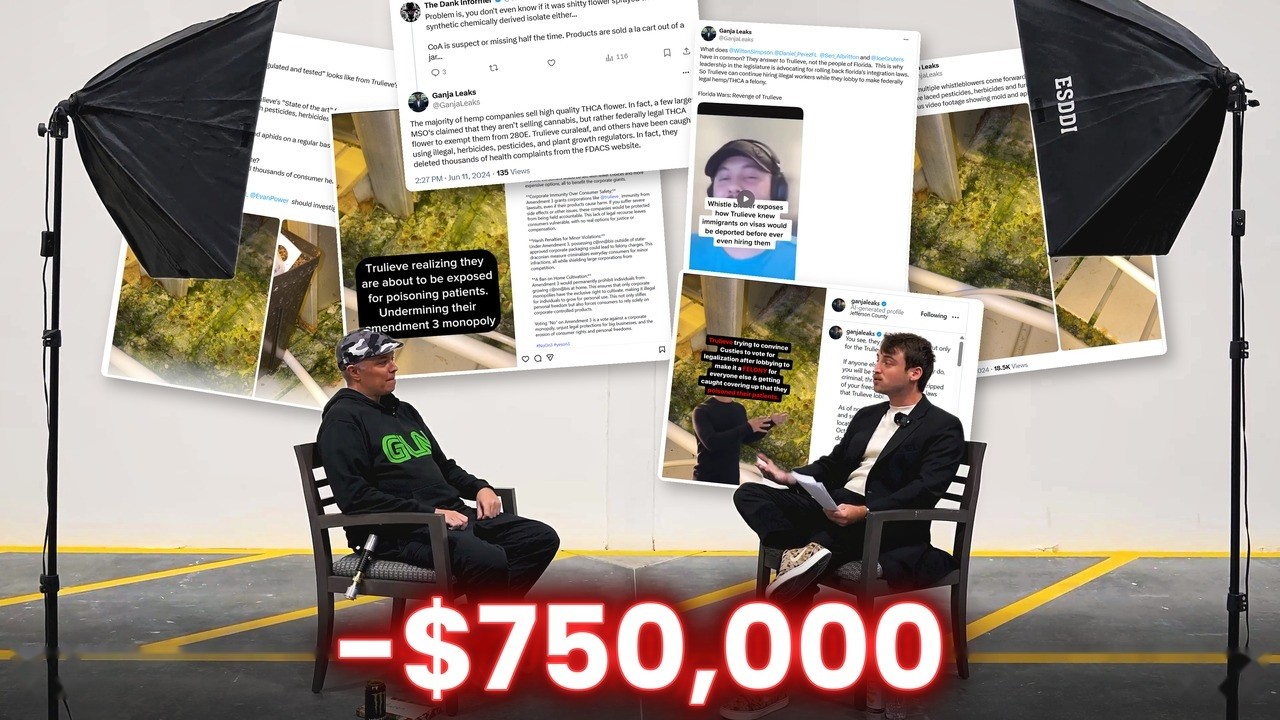

A Republican AG accuses the biggest names in weed of rigging Ohio's market to keep prices high. The companies want the case thrown out before a single email sees daylight.
By Nate "The Jedi" Jurewicz · GanjaLeaks.com
On February 5, 2026, Ohio Attorney General Dave Yost walked into the Franklin County Court of Common Pleas and accused nine of the largest cannabis companies in America of operating what his office calls unlawful "trusts," combinations formed, according to the State, to squeeze independent operators out of Ohio and keep prices from falling.
The defendants read like a roll call of the industry: Ascend Wellness, Ayr Wellness, The Cannabist Company, Cresco Labs, Curaleaf, Green Thumb Industries, Jushi Holdings, Verano Holdings, and Trulieve.
The case is State of Ohio ex rel. Dave Yost v. Ascend Wellness Holdings, Inc., et al., No. 26 CV 001146, assigned to Judge Stephen L. McIntosh. It is brought under Ohio's Valentine Act, the state's 1898 antitrust statute. The State wants an injunction, attorney fees, and forfeiture of $500 for every day each combination was in effect.
Every allegation described here is exactly that, an allegation. Nothing has been proven, no defendant has been found liable, and all nine companies deny wrongdoing. What follows comes from the public court file.
What the State says happened
Ohio's complaint describes three kinds of conduct.
The first is reciprocal dealing: companies allegedly agreeing to buy each other's product and hand each other shelf space in their own dispensaries, you carry mine, I'll carry yours. The second is the exchange of competitively sensitive, nonpublic information between companies that are supposed to be competing. The third is discriminatory supply and promotional terms, favorable deals allegedly offered to each other, according to the State, but not offered to independent Ohio operators.
In its July 14 brief answering the companies' motions to dismiss, the Attorney General's office put the theory bluntly:
"These acts were not isolated instances of misconduct by low-level employees. These acts were coordinated, systemic arrangements directed by Defendants' high-level corporate officers — including Chief Commercial Officers, Senior Vice Presidents, and Chief Business Development Officers — to stave off independent Ohio cannabis competition and prevent Ohio's cannabis prices from declining to market prices enjoyed by consumers in other states."
Read that last clause twice. The State's theory is not merely that these companies were sloppy. It is that Ohio patients paid more than patients in other states, and that this was the point.
What Ohio says Trulieve did
Trulieve's own filing is the most efficient summary of the case against it, because the company lists the allegations itself in arguing there aren't enough of them. According to Trulieve's May 15 memorandum, the State alleges:
- March 2023: Green Thumb Industries offered Trulieve a "deal" on a large quantity of distillate in Massachusetts.
- March 2024: Trulieve communicated details of an upcoming discount on Green Thumb products back to Green Thumb.
- January 2025: Trulieve's Director of Purchasing & Wholesale Business Development emailed Verano's Vice President of Procurement about planned purchasing targets and a "promo calendar."
- March 2025: Trulieve's National Account Executive emailed Curaleaf's Retail Buyer about a split promotion of Trulieve products inside Curaleaf stores.
- April and May 2025: Trulieve's Director of Wholesale exchanged details of upcoming reciprocal purchases with Ascend.
Trulieve's answer, filed by Matthew Fornshell and Kristina Dahmann of Ice Miller LLP in Columbus, is essentially that this is thin gruel. The company notes it appears in "just ten allegations," that it is not vertically integrated in Ohio, that it owns no Ohio processing plant, and that nothing in the complaint ties the conduct to Ohio specifically. The brief also disputes that an "Ohio market" exists at all:
"There is no 'Ohio' market — there are Cincinnati markets, Columbus markets, Cleveland markets, among others, and long stretches of highway between them."
The State was not impressed. Its response, filed July 14:
"Trulieve's definition of 'sparse' is artful; it cherry-picks only the Complaint paragraphs where Trulieve is specifically named. That is not how litigation works."
The fight nobody is covering
Underneath the headlines is a technical dispute that will probably decide the case, and it has almost nothing to do with cannabis.
The companies argue that Ohio's Valentine Act should be read like the federal Sherman Act, meaning the State must plead a defined market, market power, and antitrust injury with the rigor federal courts demand. The Attorney General says no: the Valentine Act contains its own pleading standard, written into the statute at R.C. 1331.09, which requires only that the State state the purpose or effects of the trust and that the defendant was a member of it. The statute expressly says a plaintiff need not plead the trust's name, its description, or "how, when, and where it was created."
Ohio also reminds the court of something that matters enormously: Ohio has never adopted the federal Twombly pleading standard. In Ohio, a complaint survives unless it appears "beyond doubt that the plaintiff can prove no set of facts" entitling it to relief, with every reasonable inference drawn in the plaintiff's favor.
If Judge McIntosh agrees with the State on that question, this case is going forward.
Meanwhile, nothing is coming out
There is one more thing worth knowing, and it may be the most consequential development so far: discovery is frozen.
The defendants moved on April 29 to stay discovery while their dismissal motions were pending. Ohio opposed. The court granted the stay, and the Amended Case Scheduling Order entered July 9 sets every remaining deadline to run from a date "after the Court's stay on discovery is lifted."
In plain English: not one internal email, not one text message between executives at competing companies, has been produced. The evidence behind those five Trulieve episodes exists somewhere in a server. Nobody outside the companies has seen it.
Briefing finished on August 28, 2026, when the last reply briefs were filed. Judge McIntosh can rule at any time. Trial is currently set for February 8, 2027.
Disclosure
Readers deserve to know where this outlet stands. Trulieve, Inc. has sued the editor of GanjaLeaks, Nathan Jurewicz, for defamation in Pasco County, Florida, Trulieve, Inc. v. Jurewicz, No. 2025-CA-001071-CAAXES, over social media posts about the company. That case is pending. He denies the allegations and is defending himself without a lawyer.
That is precisely why this article quotes the court file rather than characterizing it, links what it can, and states plainly that the Ohio allegations are unproven. The Ohio companies are entitled to their defense, and their arguments are set out above in their own words.
But the contrast is worth sitting with. In Florida, Trulieve is asking a court to punish a citizen for what he said about the company. In Ohio, Trulieve is asking a court to dismiss a state attorney general's allegations before anyone gets to look at the emails.
One of those requests is about protecting a reputation. The other is about not having to explain one.
Sources (all public record): Complaint, State of Ohio ex rel. Yost v. Ascend Wellness Holdings, Inc., et al., Franklin Cty. C.P. No. 26 CV 001146 (filed Feb. 5, 2026); Defendants' Consolidated Motion to Dismiss (May 15, 2026); Individual Defendant Trulieve Cannabis Corp.'s Motion to Dismiss and Memorandum in Support (May 15, 2026); Memorandum Contra of Plaintiff State of Ohio to Defendant Trulieve Cannabis Corp.'s Motion to Dismiss (July 14, 2026); Memorandum Contra of Plaintiff State of Ohio to Defendants' Consolidated Motion to Dismiss (July 14, 2026); Motion to Stay Discovery (Apr. 29, 2026) and Amended Case Scheduling Order (July 9, 2026). Docket available through the Franklin County Clerk of Courts, Case Information Online.
 By Ganja Guy